Destinations
Australia eSIM for Winter Travel or Summer: How Many GB From Indonesia?
The same Australia eSIM works in winter and summer. What differs is your data: summer (December-February) is spent outdoors and burns more, while winter (June-August) leans on hotel and café Wi-Fi.

Contents
- When is winter and summer in Australia?
- Does an Australia eSIM work differently in winter or summer?
- Australia eSIM for summer travel: budget data for the outdoors
- Summer tips when flying from Indonesia
- Australia eSIM for winter travel: cheaper, but don t cut it too close
- Australia eSIM for the Eid al-Adha 2027 holiday
- Australia eSIM, roaming, or a local SIM: which one fits your season?
- Australia eSIM prices by season
- So, winter or summer?
An Australia eSIM for winter travel works exactly like one for a summer trip, because mobile networks don't change with the seasons. What changes is how you burn through data. Summer (December to February) means beach photos and long road trips, while winter (June to August) pushes you indoors onto hotel Wi-Fi. So if you're flying from Indonesia, the real question isn't which eSIM survives the weather. It's how many GB and how many days you need.
Key takeaways (TL;DR)
- Summer in Australia runs from December to February and winter from June to August, the reverse of countries in the Northern Hemisphere.
- The same Australia eSIM works in any season, because the season has no effect on mobile networks or on how the eSIM is installed.
- Indonesia's Eid al-Adha holiday falls on 17 May 2027 plus collective leave days, which lines up with late autumn in Australia.
- Australia eSIM plans are data only, with no local number, and can't be topped up, so it pays to estimate your data before you fly.
When is winter and summer in Australia?
Australian summer runs from December to February, and winter runs from June to August. Autumn is March to May, and spring is September to November. The order is flipped compared with Europe, Japan, or the US, because Australia sits in the Southern Hemisphere.
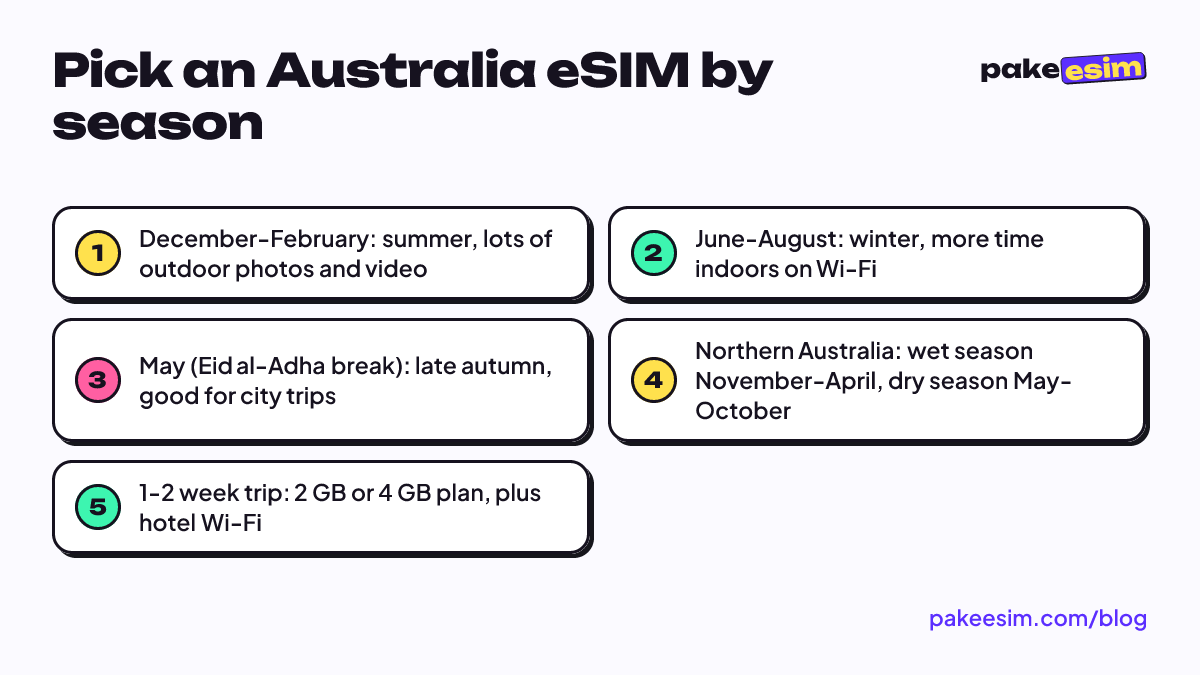
Those four seasons describe the southern cities, like Sydney, Melbourne, Adelaide, and Perth. The north plays by different rules. According to Tourism Australia's official guide to the seasons, Darwin, Kakadu, Broome, and tropical Queensland have a wet season from November to April and a dry season from May to October. A December trip to Cairns feels nothing like a December trip to Melbourne.
| Season in Australia | Months | Typical Indonesian holiday | How you use data |
|---|---|---|---|
| Summer | December-February | Christmas and New Year | Lots of photos, video, and Maps outdoors |
| Autumn | March-May | Eid al-Adha 2027 | City walks, Maps and chat |
| Winter | June-August | Mid-year school break | More time indoors, hotel Wi-Fi does the heavy lifting |
| Spring | September-November | Personal annual leave | Balanced, pleasant weather for getting around |
Does an Australia eSIM work differently in winter or summer?
No. The same Australia eSIM works in winter, summer, or anywhere in between, because an eSIM is just a digital SIM profile that connects to Australian mobile networks. The season doesn't change how you install it, how long it stays valid, or where it has coverage. The only things to adjust are your data allowance and trip length.
Apple puts the basic idea simply:
"An eSIM is an industry-standard digital SIM built into your iPhone, eliminating the need for a physical SIM card." (Apple Support on eSIM for iPhone)
One thing does feel different between seasons, and that's your own habits. In summer people spend whole days at Bondi Beach or driving the Great Ocean Road, so Maps, photo uploads, and short videos run nonstop. In winter the days are shorter. You spend longer in cafés, museums, or your hotel room, and Wi-Fi takes over part of the load.
Australia eSIM for summer travel: budget data for the outdoors
An Australia eSIM for a summer holiday should get a roomier data allowance, since you'll spend most of the day outdoors without Wi-Fi. Our rough rule: 1 GB covers about one day of Maps, chat, and moderate social media. If you video call a lot or post Reels, assume you need double.
The summer habits that eat the most data:
- Uploading beach or New Year's fireworks videos straight from the spot.
- Running Maps through hours of road trip, especially with music streaming at the same time.
- Sharing a hotspot with a friend's phone or a laptop. The hotspot uses the same data allowance.
- Video calling family in Indonesia on Christmas or New Year's Eve.
In our view, for a 7 to 10 day summer trip, the 4 GB plan is the comfortable pick if you post often but still back up photos on your accommodation's Wi-Fi. If you only post now and then, 2 GB for 15 days is enough.
Summer tips when flying from Indonesia
Christmas and New Year are busy. Buy the eSIM a few days before departure, because the validity period only starts when the eSIM first connects to a network in Australia, not when you buy it. Install the QR code over your home Wi-Fi in Indonesia, then turn on data roaming after you land in Sydney or Melbourne. The step-by-step screenshots are in our eSIM setup guide for iPhone and Android.
Australia eSIM for winter travel: cheaper, but don't cut it too close
An Australia eSIM for winter travel usually gets by with less data, because you're near Wi-Fi more often. The sun sets earlier, so outdoor time is shorter too. Even so, we think 1 GB for 7 days is too tight if you lean on Maps to catch trams in Melbourne or trains in Sydney.
For a 1 to 2 week winter holiday, the 2 GB for 15 days plan usually makes sense. If you're staying a month, say for a family visit or getting ready for university, pick a 30 day plan so the validity doesn't run out before the data does.
June to August is also a good time to head north. Darwin and Cairns are in their dry season, so the weather is far friendlier than in the wet months. The same eSIM works there too, since these plans cover all of Australia.
Australia eSIM for the Eid al-Adha 2027 holiday
An Australia eSIM for the 2027 Eid al-Adha break gets used in late autumn, just before winter. Under the 2027 national holiday and collective leave decree published by Indonesia's Ministry of State Secretariat, Eid al-Adha 1448 H falls on Monday, 17 May 2027, with collective leave on 18 May, followed by collective leave and the Vesak holiday on 19 and 20 May.
That run of days off makes the 2027 Eid al-Adha break long enough for an Australia trip, especially with a weekend attached. Usage looks a lot like winter: plenty of city sightseeing, chilly afternoons, more time indoors. The 2 GB for 15 days plan usually covers 6 to 9 days. If you want to video call family on the day itself, for example to watch Eid prayers or the qurban back home, go for 4 GB.
One honest note: these plans are data only. You don't get an Australian number for calls or texts, but your Indonesian number stays active on the phone for WhatsApp and bank OTP texts.
Australia eSIM, roaming, or a local SIM: which one fits your season?
An Australia eSIM installed before you leave Indonesia is the most practical choice for a 1 to 4 week holiday, because data works as soon as you land, with no SIM counter to hunt down. Roaming with an Indonesian carrier is convenient, but you'll need to check its daily rates yourself. A local Australian SIM suits long stays, like students or Work and Holiday visa holders.
| Option | Best for | Notes |
|---|---|---|
| Australia data eSIM | Summer, winter, or Eid al-Adha holidays | Data only, install before departure, no top-ups |
| Indonesian carrier roaming | Very short trips | Same number, check roaming rates and data with your carrier |
| Local Australian SIM | Stays of several months | Comes with a local number, bought after you arrive |
Before you buy, make sure your phone supports eSIM and isn't carrier-locked using the phone compatibility checker. Certain dual nano-SIM iPhones with model codes CH/A and ZA/A don't support this eSIM. If your route continues to New Zealand, the Oceania eSIM for Australia, New Zealand, and Fiji is easier because you won't need to switch profiles.
Australia eSIM prices by season
Australia eSIM prices are the same in every season. The table below pulls the latest prices straight from the catalog.
| Plan | Data | Validity | Price | Per day |
|---|---|---|---|---|
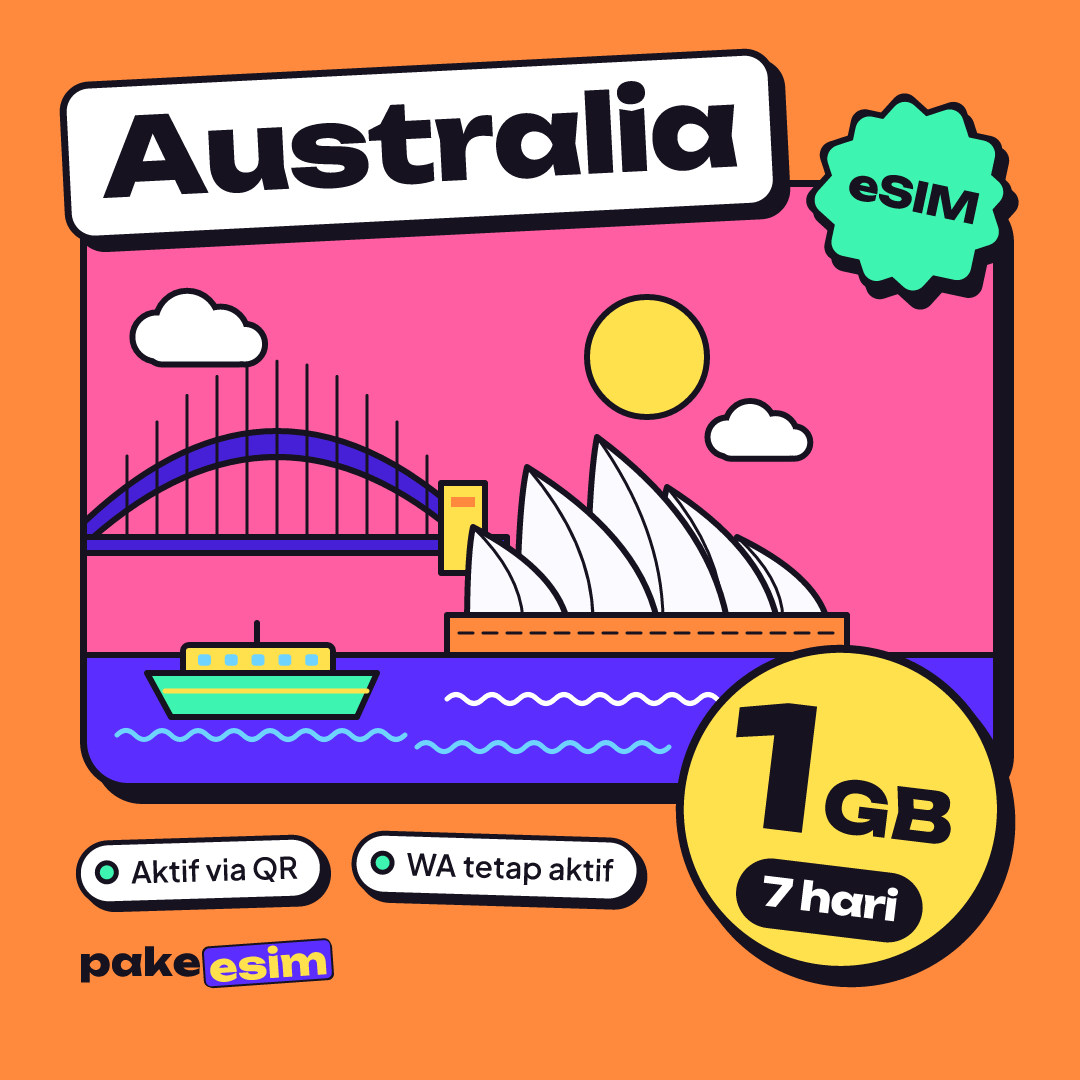
| eSIM Australia 1 GB / 7 Days | 1 GB | 7 days | Rp9.000 | ±Rp1.286 |
| eSIM Australia 2 GB / 15 Days | 2 GB | 15 days | Rp28.500 | ±Rp1.900 |
| eSIM Australia 3 GB / 30 Days | 3 GB | 30 days | Rp39.900 | ±Rp1.330 |
| eSIM Australia 4 GB / 30 Days | 4 GB | 30 days | Rp62.700 | ±Rp2.090 |
Payment is online through the payment page: bank virtual accounts, QRIS, GoPay, ShopeePay, convenience stores, or credit card, in rupiah, with the total matching the plan price exactly and the order confirmed automatically once paid. For a fuller data breakdown by activity and the phone requirements for tourists, read the complete Australia eSIM guide for tourists: data, setup, and the 000 rule.
So, winter or summer?
Pick the season from your holiday plans, not from the eSIM. Summer is for beaches and road trips. Winter suits cities and the dry north, and the May 2027 Eid al-Adha break lands in cool late autumn. Once your dates are set, size your data to your habits, install the eSIM before you fly, and enjoy the trip. You can browse the plans in the Pakeesim Australia eSIM catalog.