Destinations
New Zealand eSIM in the Winter Months or Summer? July vs December Data
New Zealand's summer runs December to February and its winter months run June to August. The eSIM stays the same all year; what changes is how you use data, from ski days in July to New Year road trips.

Contents
- Is it winter or summer in New Zealand right now?
- Why are New Zealand s seasons different from Indonesia s?
- New Zealand eSIM in the winter months: school holidays and snow
- New Zealand eSIM in summer: New Year and road trips
- Oceania eSIM, roaming, or a local SIM: which one?
- Which plan fits a seminar, school holiday, or year-end trip?
- Before you fly to New Zealand
New Zealand sits in the Southern Hemisphere, so its seasons run opposite to what most travelers from Asia, Europe, or North America expect. December to February is summer, and the winter months are June to August. A New Zealand eSIM works the same in winter or summer: the setup and the network don't change. What changes is how you burn through data. A June or July trip means snow and short days, while a December trip means late sunsets and long road trips. Either way, the plan is the same Oceania eSIM covering Australia, New Zealand, and Fiji.
Key takeaways (TL;DR)
- Summer in New Zealand runs from December to February, and winter runs from June to August.
- NIWA recorded a nationwide average temperature of 9.1°C for winter 2025 and 16.9°C for summer 2025-2026 in New Zealand.
- The Pakeesim Oceania eSIM works in Australia, New Zealand, and Fiji on one profile, and it is data only, with no phone number or SMS.
- The Oceania eSIM validity period starts when it first connects to a network in the destination country, not on the day you buy it.
- As a store rule of thumb, 1 GB covers roughly one day of maps, chat, and moderate social media use.
Is it winter or summer in New Zealand right now?
New Zealand in late October is in spring, the season that runs from September to November. Temperatures are climbing, and summer arrives in December. So if you're asking whether it's winter or summer there right now, the honest answer is neither: it's the shoulder season heading into summer.
The rough month-by-month picture looks like this, along with the Indonesian school and public holidays that tend to fall in each period (useful if you're traveling from Indonesia, where Pakeesim is based).
| Months | Season in New Zealand | Indonesian holidays that often overlap | What it means for your data |
|---|---|---|---|
| December–February | Summer | Christmas, New Year, odd-semester break | Long days, lots of photos and video, Maps running on the road |
| March–May | Autumn | Eid al-Fitr holiday (depends on the year) | Weather changes fast, check the forecast every morning |
| June–August | Winter | End-of-school-year break | Short days, batteries drain faster, more time indoors |
| September–November | Spring | Few long holidays, good for seminars or work trips | Shoulder season, quieter travel |
You can check the numbers yourself. NIWA, New Zealand's climate research institute, reported a nationwide average summer temperature of 16.9°C for 2025-2026. That's a lot cooler than "summer" in Jakarta or Singapore.
Why are New Zealand's seasons different from Indonesia's?
Indonesia sits around the equator, so it only has a dry season and a rainy season. New Zealand is far south of the equator, which flips its four seasons relative to Europe or Japan. When Tokyo has snow in January, Auckland is in the middle of summer.
People who search for "new zealand esim winter months" are often asking two things at once. First, does the eSIM itself change by season? No. An eSIM is a digital SIM profile you install by scanning a QR code, and the plan is the same all year. Second, will an eSIM bought before you leave work once you're there? Yes, as long as your phone supports eSIM and isn't carrier-locked. The only thing that shifts with the season is how you use data.
New Zealand eSIM in the winter months: school holidays and snow
New Zealand's winter months run from June to August, which lines up with the long end-of-school-year break in Indonesia. NIWA put the nationwide average for winter 2025 at just 9.1°C, and mountain areas like Queenstown or Wanaka can get much colder than that.
"The nationwide average temperature in winter 2025 was 9.1°C." (NIWA)
Cold hits your phone directly. Apple says iPhone works best at 0° to 35° C ambient temperatures, and in very cold conditions battery performance can drop temporarily. On a ski slope, a phone showing 40% can suddenly shut off right when you need Maps to get back down.
Practical tips for a June or July trip:
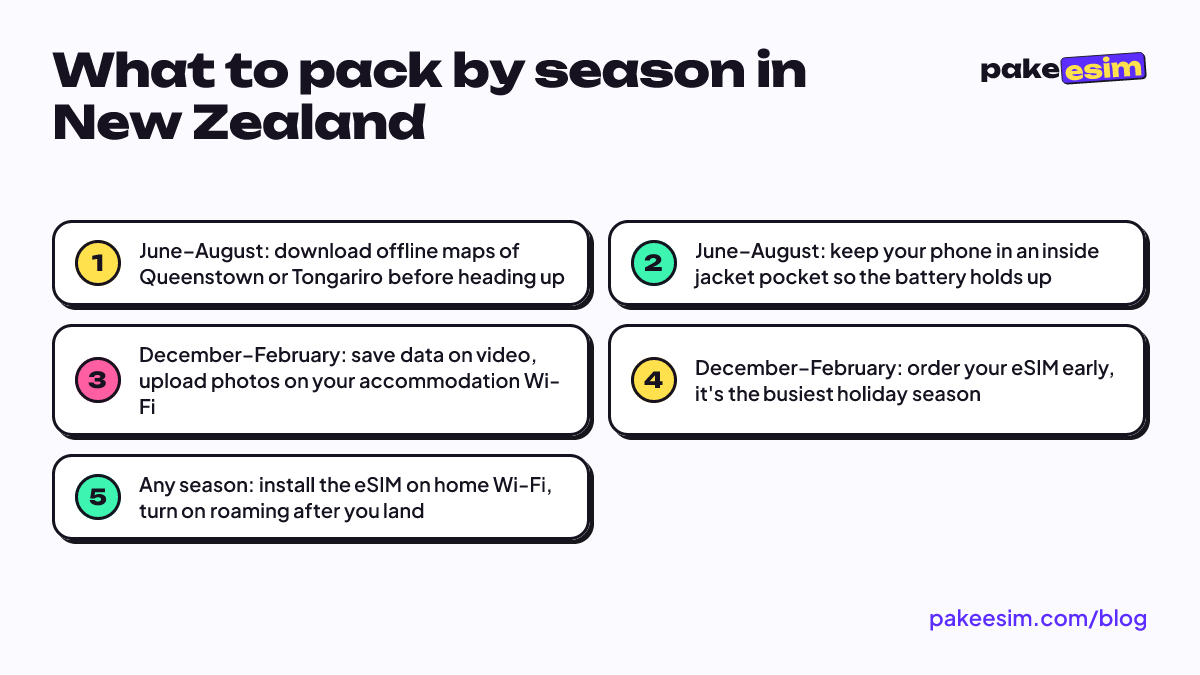
- Download offline maps before you leave your accommodation, especially routes to ski fields and national parks.
- Bring a power bank and keep your phone in an inside pocket, not the outer pocket of your jacket.
- Days are short, so you'll likely spend more time indoors. Use that Wi-Fi for photo uploads and video calls.
- Kids on school holiday love watching videos in the car. Download shows over Wi-Fi first instead of streaming on eSIM data.
New Zealand eSIM in summer: New Year and road trips
Summer in New Zealand runs from December to February, right over Christmas and New Year. It's the busiest season, and data use usually climbs with it because the days are longer and you're outside more.
The classic summer pattern is the road trip. A day driving from Christchurch to Tekapo means Maps on for hours, plus posting lake photos to Instagram and checking where you'll sleep the next night. In our view, 1 GB is too tight for a 7-day road trip like that.
If you're flying in for New Year, watch the validity period and the time difference too. We cover that in our guide to New Zealand eSIM validity over New Year. For year-end trips, order your eSIM a few days before departure. The validity only starts once it connects in New Zealand, so buying early doesn't cost you any days.
Oceania eSIM, roaming, or a local SIM: which one?
For most visitors, a data eSIM is the most practical option because you install it before you fly and your home number stays active for WhatsApp and bank OTP codes. Roaming with your home carrier also works, but check its rates in your carrier's app first. A local SIM makes sense if you need a New Zealand phone number.
| Option | Pros | Cons |
|---|---|---|
| Oceania eSIM | Installed at home, one profile for Australia, New Zealand, and Fiji | Data only, no local number, can't be topped up |
| Home carrier roaming (e.g. Telkomsel, XL, Indosat) | Nothing to install, same number | Price and data depend on the carrier's roaming package |
| New Zealand local SIM | You get a local number | Bought after arrival, phone needs a free SIM slot |
A route that combines Sydney and Auckland only needs one Oceania eSIM. If most of your trip is in Australia, read our Australia eSIM guide for winter or summer travel, since its seasons are flipped too.
Which plan fits a seminar, school holiday, or year-end trip?
Pick a plan based on trip length and how often you'll be away from Wi-Fi. A 5 to 7 day seminar or conference usually works with a small plan, since campuses and hotels have Wi-Fi. A two-week school holiday or a year-end road trip calls for a 30-day plan with the most data.
Current Oceania plan prices are in the table below (prices may change). Prices are in Indonesian rupiah, and you can pay online by bank virtual account, QRIS, GoPay, ShopeePay, convenience store, or credit card.
| Plan | Data | Validity | Price | Per day |
|---|---|---|---|---|
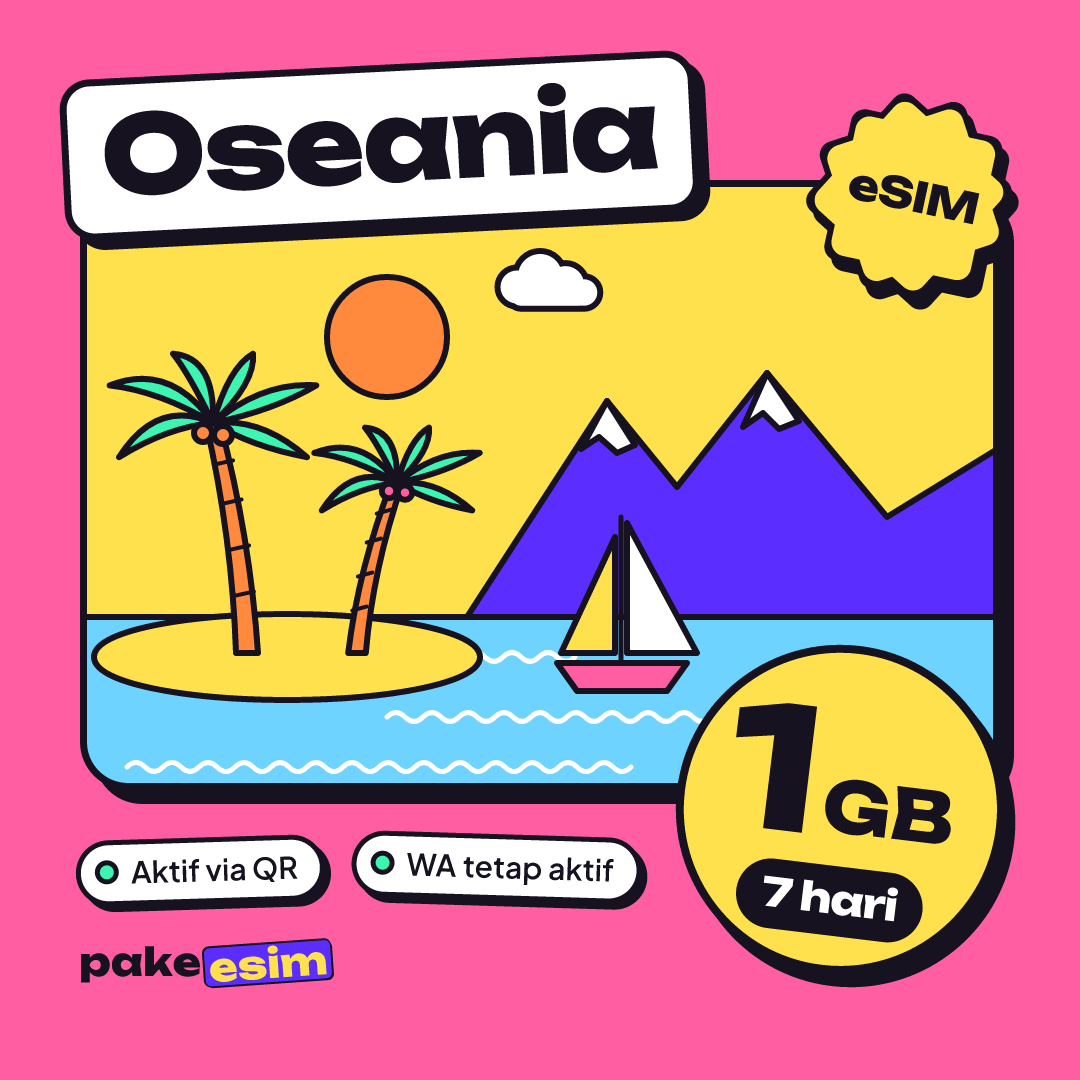
| eSIM Oceania 1 GB / 7 Days | 1 GB | 7 days | Rp9.000 | ±Rp1.286 |
| eSIM Oceania 2 GB / 15 Days | 2 GB | 15 days | Rp28.500 | ±Rp1.900 |
| eSIM Oceania 3 GB / 30 Days | 3 GB | 30 days | Rp39.900 | ±Rp1.330 |
| eSIM Oceania 4 GB / 30 Days | 4 GB | 30 days | Rp62.700 | ±Rp2.090 |
The rough math uses the rule of thumb of 1 GB for about one day of maps, chat, and moderate social media. By that measure, even the largest plan won't last if every day is a heavy day. The trick is splitting roles: eSIM data for Maps, chat, and checking schedules on the move, and video uploads or video calls saved for Wi-Fi.
- Seminar or conference season (3 to 7 days). The 1 GB / 7 days plan is enough if you spend most of your time at the venue. Go for 2 GB / 15 days if you're sightseeing afterward.
- School holidays (10 to 14 days, winter). The 3 GB / 30 days plan makes sense for one parent's phone acting as navigator. Everyone else can share a hotspot or use the accommodation Wi-Fi.
- Year-end road trip (summer). Take 4 GB / 30 days, because Maps runs longer and you're outdoors more often.
If you run out of data mid-trip, the plan can't be topped up. You'll need to buy a new QR code and install it, so it's easier to do that while you still have Wi-Fi.
Before you fly to New Zealand
eSIM prep is the same for winter or summer, and it's best done before you leave home. Apple's support page confirms that if your carrier gives you a QR code, you can use it to set up an eSIM on iPhone.
- Check that your phone supports eSIM and isn't carrier-locked on our phone compatibility checker.
- Pay online on the payment page, by bank virtual account, QRIS, GoPay, ShopeePay, convenience store, or credit card, following our payment guide. The order is confirmed automatically once paid, and unpaid orders expire after 3 hours.
- Install the eSIM while you're on home Wi-Fi, following the eSIM setup guide or our walkthrough on how to install an eSIM on iPhone.
- After landing in Auckland, Christchurch, or Queenstown, set the eSIM as your cellular data line and turn on Data Roaming for it.
Snow in July or sunshine in December, it's still one eSIM. Pick your data by season, then browse all Oceania plans once your travel dates are set.