Destinations
Thailand eSIM for Winter or Summer Travel? December vs April Data and Price
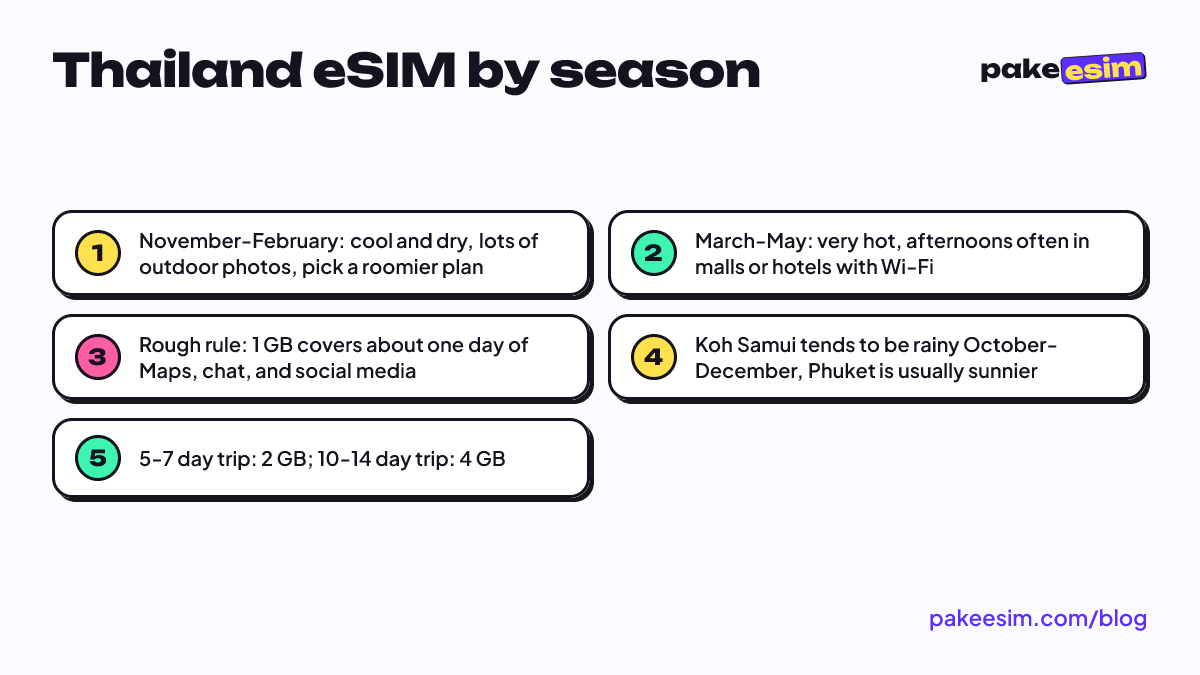
The same Thailand eSIM works in winter and summer. What changes is your data use: the cool season (November-February) keeps you outdoors, while the hot season (March-May) pushes afternoons into malls and hotels with Wi-Fi.

Contents
- When is winter and summer in Thailand?
- Does a Thailand eSIM work differently in winter or summer?
- Thailand eSIM for winter travel: data for the year-end holidays
- Pick your beach by season
- Buy before the busy season
- Thailand eSIM for summer travel: less data, if you know the pattern
- How much does a Thailand eSIM cost in winter or summer?
- Which is better for Thailand: eSIM, roaming, or a local SIM?
- So, winter or summer for Thailand?
The same Thailand eSIM works for winter or summer travel, because the mobile network does not change with the seasons. What changes is how you use data. Thailand's "winter" (roughly November to February) is cool and dry, so people spend whole days outside at temples, night markets, and Andaman beaches. Summer (roughly mid-March to mid-May) is brutally hot, and afternoons tend to move indoors to malls and hotels with Wi-Fi. So when you plan a Thailand eSIM for winter or summer travel, the real question is how many GB you need for how many days.
Key takeaways (TL;DR)
- Thailand's winter, or cool season, runs roughly from November to February, with temperatures of about 18 to 28 degrees Celsius and no snow.
- Thailand's summer, or hot season, runs roughly from mid-March to mid-May, with average temperatures of 28 to 38 degrees Celsius.
- A Thailand eSIM works the same in every season, because the season does not change the network, the setup steps, or the validity period.
- Thailand eSIM plans are data only, with no local number for calls or SMS, and they cannot be topped up.
- Winter trips to Thailand usually use more mobile data, because more of the day is spent outdoors away from Wi-Fi.
When is winter and summer in Thailand?
Thailand's winter, usually called the cool season, runs roughly from November to February, and summer (the hot season) follows from mid-March to mid-May. The rest of the year, about mid-May to October, is the rainy season brought by the southwest monsoon. These three seasons apply to most of the country, from Bangkok to Chiang Mai.
Winter in Thailand is nothing like winter in Korea or Japan. The Tourism Authority of Thailand puts it this way:
"From November to February, Thailand experiences its cooler months, with temperatures ranging from 18°C to 28°C." (TAT News on Thailand's seasons)
Still warm, right? The difference is drier air and more comfortable evenings. Up in the northern mountains, around Doi Inthanon, early mornings can be a lot colder, so pack a light jacket if you are heading there.
The start date also shifts a little each year. The Thai Meteorological Department announces the start of the cool season based on changing wind patterns. In 2023, for example, the Thai Meteorological Department's announcement of the cool season only came out in mid-November.
| Season in Thailand | Approximate months | Typical Indonesian holiday | Data use pattern |
|---|---|---|---|
| Winter (cool season) | November-February | Christmas, New Year, semester break | Mostly outdoors: temples, night markets, Andaman beaches |
| Summer (hot season) | Mid-March to mid-May | Personal annual leave | Afternoons in malls and hotels, outdoor plans shift to evenings |
| Rainy season | Mid-May to October | Mid-year school holidays | Lots of sheltering indoors, café Wi-Fi gets used too |
Does a Thailand eSIM work differently in winter or summer?
No. A Thailand eSIM is a digital SIM profile that connects to Thai mobile networks, and it behaves the same in December as it does in April. The season does not change how you install it, how long it stays valid, or where it has coverage. The only things to adjust are the data allowance and the length of your trip.
Setup is identical all year. Apple's official guide to setting up eSIM on iPhone says that if your carrier gives you a QR code, you can use it to set up the eSIM. Install the QR code over your home Wi-Fi before you fly, then turn on data roaming for the eSIM line once you land at Suvarnabhumi or Don Mueang. Screenshots for each step are in our eSIM installation guide for iPhone and Android.
What really differs between seasons is your own routine, for example:
- Winter: hours of walking around Wat Pho and Chatuchak, Maps open the whole time, Instagram stories going up all day.
- Summer: from noon to 3 p.m. you would rather hide in the air conditioning at Siam Paragon, and your phone switches to mall Wi-Fi.
- Both seasons: booking Grab or Bolt, checking the BTS map, translating menus at street stalls.
Thailand eSIM for winter travel: data for the year-end holidays
A Thailand eSIM for a November to February trip should come with a roomier data allowance, because the pleasant weather keeps you outdoors longer and away from Wi-Fi. Christmas, New Year, and Indonesian semester breaks all fall in this window too, so Bangkok, Chiang Mai, and Phuket are usually packed with tourists.
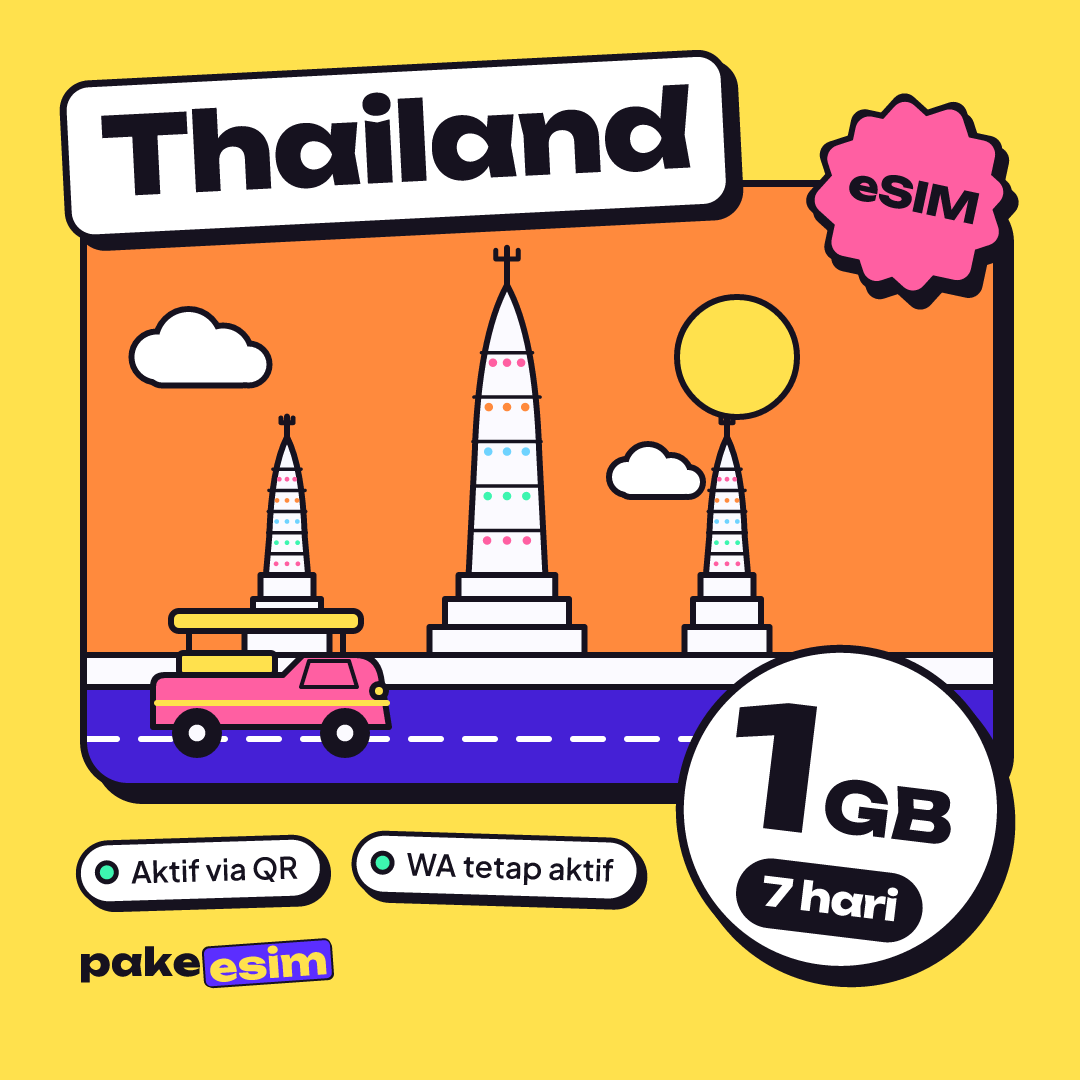
Our rough rule of thumb: 1 GB lasts about one day of Maps, chat, and moderate social media. If you make a lot of video calls or post Reels, double that. Honestly, we think the 1 GB for 7 days plan is too tight for a winter holiday, unless you are only spending two or three days in Bangkok on a stopover.
For a 5 to 7 day trip, 2 GB is usually enough as long as you upload photos and videos over hotel Wi-Fi. For 10 to 14 days, or if you share a hotspot with a partner, go for 4 GB.
Pick your beach by season
Not every Thai beach is sunny in winter. According to the Thailand climate guide from Thailand Privilege, the eastern Gulf coast, including Koh Samui, actually sees its heaviest rain around October to December, while Phuket and the Andaman coast have their rainy season from May to October. A December trip to Phuket or Krabi is usually a safer bet for weather than Koh Samui.
Rain does not stop an eSIM from working. A rainy day just means more time in a café or villa, where Wi-Fi picks up part of your usage.
Buy before the busy season
A Thailand eSIM's validity starts when it first connects to a network in Thailand, not when you buy it. That means you can safely buy a few days before departure and install it calmly at home, instead of queuing at an airport SIM counter in peak season.
Thailand eSIM for summer travel: less data, if you know the pattern
A Thailand eSIM in summer can usually get by with a slightly smaller plan, since the midday heat pushes you indoors where there is Wi-Fi. TAT News puts average hot-season temperatures at 28 to 38 degrees Celsius, and anyone who has walked down Khao San Road at 1 p.m. in April knows exactly what that feels like.
Your day shifts toward late afternoon and night: night markets, rooftop bars, and wandering once the sun drops a bit. For a 5 to 7 day trip, 2 GB for 15 days generally makes sense. That 2 GB plan also suits a short business trip spent mostly in offices or hotels.
One note. Extreme heat can make your phone overheat when Maps and the camera run together in direct sun. That is a battery and phone temperature issue, not an eSIM issue, so keep the phone in your bag when you are not using it and carry a power bank.
How much does a Thailand eSIM cost in winter or summer?
A Thailand eSIM costs the same in winter and in summer. There is no peak-season pricing, and the table below pulls the latest prices straight from the catalog, since prices can change at any time.
| Plan | Data | Validity | Price | Per day |
|---|---|---|---|---|
| eSIM Thailand 1 GB / 7 Days | 1 GB | 7 days | Rp17.100 | ±Rp2.443 |
| eSIM Thailand 2 GB / 15 Days | 2 GB | 15 days | Rp28.500 | ±Rp1.900 |
| eSIM Thailand 3 GB / 30 Days | 3 GB | 30 days | Rp39.900 | ±Rp1.330 |
| eSIM Thailand 4 GB / 30 Days | 4 GB | 30 days | Rp62.700 | ±Rp2.090 |
Plans range from 1 GB for 7 days up to 4 GB for 30 days. The 30-day plans are handy for longer stays, say a month of remote work in Chiang Mai during the cool season. Every plan is data only. You do not get a Thai number for calls or SMS, but your Indonesian number stays active on your phone for WhatsApp and bank OTP texts.
Payment is online through Midtrans, in rupiah, using a bank virtual account, QRIS, GoPay, ShopeePay, a convenience store, or a credit card. The total is exactly the plan price with no admin fee, and the order is confirmed automatically once paid. The details are on our page about paying for an eSIM.
Which is better for Thailand: eSIM, roaming, or a local SIM?
A Thailand eSIM installed before you leave Indonesia is the most practical choice for trips of a few days up to a month, because data works the moment you land. Roaming suits very short trips, and a Thai local SIM suits long stays that need a local number.
Roaming from an Indonesian carrier keeps your number unchanged, but you need to check its rates and allowance with your carrier yourself.
| Option | Best for | Notes |
|---|---|---|
| Thailand data eSIM | Winter holidays, summer trips, or business travel | Data only, install before you fly, no top-ups |
| Indonesian carrier roaming | 1-2 day trips | Same number, check roaming rates with your carrier |
| Thai local SIM | Stays of several months | Local number included, bought after you arrive |
Before buying, make sure your phone supports eSIM and is not carrier-locked using our phone eSIM compatibility checker. Certain dual nano-SIM iPhones with CH/A and ZA/A model codes do not support this eSIM. If your route continues to Vietnam, Cambodia, or Malaysia, look at the Asia eSIM covering 20 countries so you do not have to switch profiles at every border.
So, winter or summer for Thailand?
Choose the season based on your holiday plans, not on the eSIM. Winter is great for city sightseeing, a trip up to Chiang Mai, and the Andaman beaches. Summer works if you can handle the heat and love the nightlife.
Once your dates are set, size your data to your habits and install the eSIM before you fly. For a more detailed GB-per-day breakdown and fixes when an eSIM won't connect, read our Thailand eSIM guide for tourists, or go straight to the Thailand eSIM plans in the catalog.