Destinations
Best eSIM for Africa 2026: Regional vs Global vs Local SIM Compared
The best eSIM for Africa covers every country on your route. A 12-country Africa eSIM suits Kenya, Tanzania, Uganda, or South Africa trips; a Global eSIM fits routes that add the US or Europe.

Contents
- What is the best eSIM for Africa?
- Africa eSIM vs Global eSIM vs local SIM vs roaming
- Which Africa eSIM works best in Kenya, Uganda, and South Africa?
- How much does the best eSIM for Africa cost in 2026?
- How many GB do you need for a safari or a month in Africa?
- Does an Africa eSIM work in the USA?
- Setting up an Africa eSIM on iPhone or Android
- Africa eSIM over Christmas and New Year
- Before you fly
The best eSIM for Africa is the one that covers every country on your route, fits your data use, and actually installs on your phone. For a trip that stays inside Kenya, Tanzania, Uganda, South Africa, Morocco, or Egypt, a regional Africa eSIM is the simplest pick. If your itinerary also passes through the US, Europe, or the Gulf, a Global eSIM makes more sense. Before comparing prices, check two things: your phone supports eSIM, and it isn't carrier-locked.
Key takeaways (TL;DR)
- The Africa eSIM sold by Pakeesim covers 12 countries: Egypt, Ghana, Kenya, Madagascar, Mauritius, Morocco, Nigeria, Senegal, South Africa, Tanzania, Tunisia, and Uganda.
- The Global eSIM covers all 12 of those African countries plus the United States, Europe, and Asia, 88 countries in total.
- Rwanda, Ethiopia, Namibia, Botswana, Zambia, and Zimbabwe are not on either list, so a safari crossing those borders needs another plan.
- A rough rule of thumb is 1 GB per day of maps, chat, and moderate social media, doubled if you video call or stream.
- Every plan is data only, with no local phone number, and checkout is online in rupiah with no admin fee, confirmed automatically once paid.
What is the best eSIM for Africa?
The best eSIM for Africa is a regional plan when all your stops are among the 12 covered countries, and a Global plan when your route leaves that list. Both run on one profile, so you don't swap anything when you fly from Nairobi to Kilimanjaro or from Cairo to Marrakech.
"Best" also depends on things a price chart won't tell you:
- Coverage of your exact route. Africa has 54 countries and no regional eSIM covers all of them. Read the country list before anything else.
- Validity versus trip length. A 7-day plan for a 10-day safari means buying a second eSIM halfway through.
- Your phone. An eSIM that can't install is the most expensive one. Our phone compatibility checker shows what to look for, including the EID you see when you dial *#06#.
- How you pay. Pakeesim's checkout runs through Midtrans: bank virtual accounts, QRIS, GoPay, ShopeePay, convenience stores, or credit card, all in rupiah, with the total matching the plan price exactly.
Africa eSIM vs Global eSIM vs local SIM vs roaming
An Africa eSIM wins on convenience for multi-country trips inside its 12 countries, a local SIM can be cheaper per GB if you stay long in one country, and home-operator roaming is the easiest but usually the priciest. The table below sums up the trade-offs.
| Option | Covers | Setup | Phone number | Best for |
|---|---|---|---|---|
| Africa eSIM | 12 African countries, one profile | Scan a QR code at home on Wi-Fi | No, data only | Safari or multi-country trips within the list |
| Global eSIM | 88 countries incl. all 12 African ones | Same QR setup | No, data only | Africa plus a US, Europe, or Middle East leg |
| Local SIM (e.g. in Kenya) | One country | Buy in a shop, register with your passport | Yes, local number | Long stays in one country |
| Roaming from your Indonesian operator | Depends on operator deals | Activate a roaming pack | Your own number | Short trips when cost matters less |
Local SIMs come with paperwork. Kenya's SIM card registration regulations require subscribers to register with identification, which for visitors means a passport. That's fine on day three in Nairobi, less fun at a border post after a long drive. Roaming prices change often, so check your operator's current Africa rate before you decide.
Which Africa eSIM works best in Kenya, Uganda, and South Africa?
In Kenya, Uganda, and South Africa, the Africa eSIM and the Global eSIM both work, because all three countries are on both lists. The real question is where else you're going. A Nairobi, Masai Mara, and Kampala loop fits the Africa plan neatly; a Johannesburg trip with a stop in Dubai fits the Global plan.
A few country notes that matter more than the brand name on the QR code:
- Kenya and Tanzania are common safari pairs, and both are covered. A Serengeti and Masai Mara combo needs no second eSIM.
- Uganda is covered, but neighboring Rwanda is not. Gorilla trekking trips often cross into Rwanda, so plan for Wi-Fi or a separate solution there.
- South Africa is covered, while Namibia and Botswana are not. A Cape Town to Okavango overland trip will lose data at the border.
- Morocco, Egypt, and Tunisia cover most North Africa itineraries. Egypt also appears in the Middle East plan if you're combining it with Jordan.
Signal in game reserves is another matter. Any eSIM uses local networks, so if there's no tower near your camp, there's no data, whatever plan you bought.
How much does the best eSIM for Africa cost in 2026?
As of October 2026, the Africa eSIM comes in four sizes, from 1 GB for 7 days up to 4 GB for 30 days, priced in rupiah with no admin or delivery fee. The live table below always shows the current price, so you don't have to trust a number someone typed months ago.
| Plan | Data | Validity | Price | Per day |
|---|---|---|---|---|
| eSIM Africa 1 GB / 7 Days | 1 GB | 7 days | Rp9.000 | ±Rp1.286 |
| eSIM Africa 2 GB / 15 Days | 2 GB | 15 days | Rp28.500 | ±Rp1.900 |
| eSIM Africa 3 GB / 30 Days | 3 GB | 30 days | Rp39.900 | ±Rp1.330 |
| eSIM Africa 4 GB / 30 Days | 4 GB | 30 days | Rp62.700 | ±Rp2.090 |
People also search for an "Africa eSIM cost per month." The 30-day plans are effectively the monthly option. There is no subscription and no top-up: when the data runs out, you buy a new eSIM and scan the new QR code. Validity starts when the eSIM first connects to a network at your destination, not when you pay, so buying a week early costs you nothing. If you're comparing a "Uganda" or "Kenya" price, it's the same regional plan, since one Africa eSIM serves all 12 countries.
How many GB do you need for a safari or a month in Africa?
For most travelers in Africa, 1 GB per day of maps, chat, and some social media is a fair estimate, and video calls double it. That makes a 7-day trip with light use fit the 2 GB plan, and a 10 to 14 day safari with daily photo uploads fit the 4 GB plan.
Our honest take: 1 GB for 7 days is tight for anyone using Google Maps in Cape Town traffic every day. It works if you're mostly on lodge or hotel Wi-Fi and only need WhatsApp on the road. A short multi-country trip of up to two weeks is where the 2 GB, 15-day plan earns its spot.
For a month-long overland trip, or if you'll hotspot a laptop, the 4 GB, 30-day plan is the safer pick. Download offline maps of the parks before you leave so your data goes to messages, not map tiles.
Running out halfway is not a disaster. Buy another plan, install it on hotel Wi-Fi, and switch your data line. Our Africa eSIM plans guide with safari data needs goes through the math in more detail.
Does an Africa eSIM work in the USA?
No. An Africa eSIM only connects in the 12 African countries it lists, so it won't work in the United States, including on a layover. If your trip runs Jakarta, New York, then Johannesburg, the Global eSIM covers both the US and South Africa on one profile.
If you're spending most of the trip in America, a dedicated plan is cleaner. Our USA eSIM guide covers how much data a US trip needs. This is also the short answer to "what Africa eSIM works best in the USA for iPhone": none of them, because the coverage is regional, not tied to the phone model.
Setting up an Africa eSIM on iPhone or Android
An Africa eSIM installs the same way on iPhone and Android: scan the QR code while you're still on Wi-Fi at home, then turn on data roaming for the eSIM line after you land. Apple puts the core requirement plainly.
"To use your iPhone with another carrier when traveling internationally, your iPhone cannot be locked to a carrier" (Apple Support on travel eSIM)
To check, go to Settings, General, About, and look at Carrier Lock. According to Apple's guide to carrier-locked iPhones, "No SIM restrictions" means you're free to use another carrier's eSIM. Certain dual nano-SIM iPhones with CH/A or ZA/A model codes don't support eSIM at all. The full steps with screenshots are in our eSIM installation guide, and if it installs but won't connect, see Africa eSIM not working on iPhone.
Africa eSIM over Christmas and New Year
December and January are peak months for Cape Town, Zanzibar, and Kenyan safaris, so plan your eSIM before the holiday rush. Customer support runs 08.00 to 22.00 WIB, and payment is confirmed automatically, so the QR code appears on your order page and in your email once it goes through.
Three practical moves for a holiday trip:
- Order a few days before you fly. Validity only starts on the first connection in Africa.
- Size up. Holiday trips mean more photos and video calls home, so the 4 GB plan is usually worth it.
- Pay online through Midtrans: bank virtual accounts, QRIS, GoPay, ShopeePay, convenience stores, or credit card. Unpaid orders expire after 3 hours. The payment guide has the details.
If you'll cross from Africa into Europe or the Middle East over New Year, our article on eSIM validity in Africa over New Year compares the plans by trip length.
Before you fly
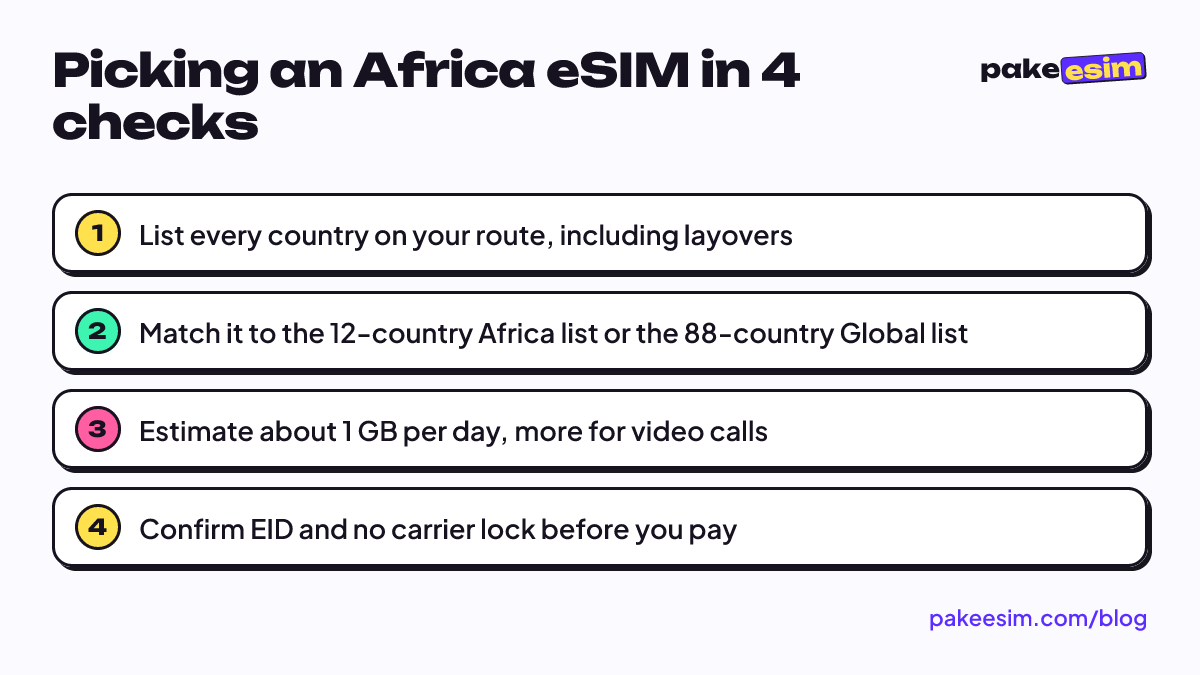
Write down every country on your route, layovers included, and check it against the 12-country Africa list. If something's missing, look at the Global plan or accept Wi-Fi for that leg. Confirm your phone has an EID and no carrier lock, pick a plan by days and GB, and install it at home. Then the first thing you do at Jomo Kenyatta or O. R. Tambo is switch on data roaming, not queue at a SIM counter.